Tiếng Việt
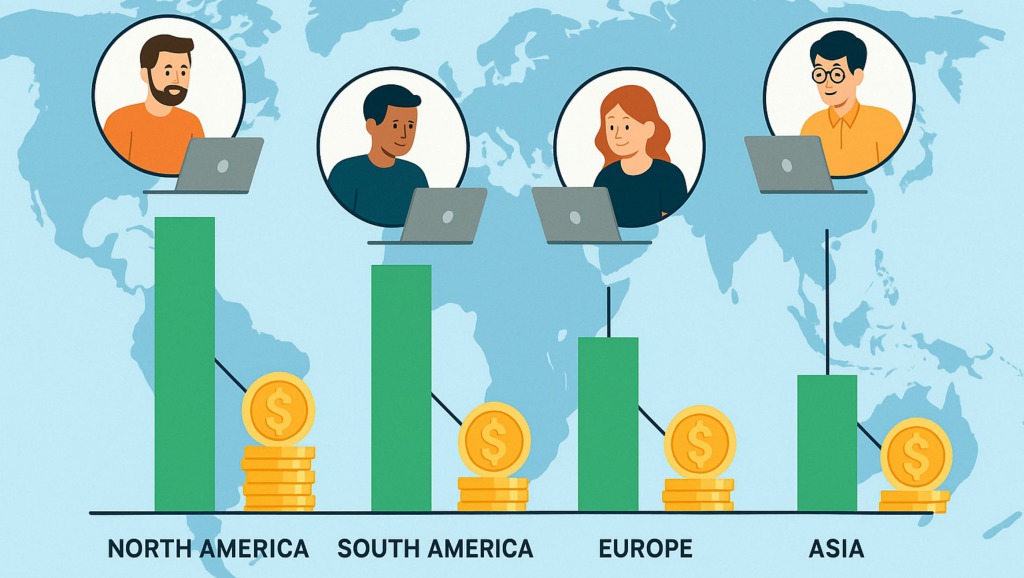
According to the article “How Much Does it Cost to Hire a Software Developer in India?” cpublished by Vrinsofts, a global comparison of software outsourcing costs shows that hiring a software engineer in India can cost as little as USD 15 per hour. Meanwhile, the article “How Much Does It Cost to Hire a Software Developer: A Complete Guide” by SpaceO indicates that the same role in the United States can cost up to USD 150 per hour. What explains such a significant difference?
As more and more Vietnamese companies turn to offshore outsourcing to reduce costs, very few truly understand why there is such a dramatic price gap between regions, or where the line lies between “smart cost savings” and “low cost with high risk.”
This article will help you understand the core factors that determine global software outsourcing costs.
Cost of living and minimum wage by country
This is the most fundamental factor influencing offshore software development costs. Countries with a high cost of living such as the United States, the United Kingdom, and Singapore must pay salaries that are several times higher than those in developing countries.

In the United States, the annual salary of a senior software developer typically ranges from USD 120,000 to USD 180,000. In contrast, in Vietnam, the average annual salary for a senior developer is only around USD 20,000 to USD 30,000. Even with comparable skill levels, the per-person cost can be five to six times lower.
Technical capability, experience, and depth of expertise
Cost is influenced not only by geography but also by the actual capabilities of the development team. Regions with more specialized skills tend to charge higher rates, but their productivity is often significantly higher as well.
| Country | Typical technical strengths |
| Ukraine | Complex backend systems, fintech, AI, IoT |
| India | Large workforce, wide range of technologies |
| Vietnam | Web applications, mobile applications, ERP/CRM systems |
| Philippines | QA, technical support, BPO |
| USA / UK | Product management, large-scale system architecture |
Differences in project management processes and quality standards
A company with a well-structured Agile process, using CI/CD, managing projects with Jira, and conducting regular code reviews will have higher software outsourcing costs, but this significantly reduces risk and improves scalability.

In developed markets such as the United States and the European Union, these practices are considered mandatory standards. In some low-cost markets, businesses may face situations where there is no proper documentation, no testing, or no post-delivery warranty. This is why the reality of “cheap at first, expensive later” is a common outcome when project management processes are not carefully evaluated.
>>> See also: The budget optimization formula for software outsourcing used by large enterprises
Legal framework, data security, and international standards
In regions such as the EU, the US, and Singapore, compliance with standards like GDPR, ISO 27001, SOC 2 is almost mandatory. Vendors that fully comply with these requirements usually have higher costs due to the significant investment needed to maintain security and compliance.

Conversely, working with vendors that lack clear contracts or NDAs can expose businesses to legal risks and data loss, especially in projects related to finance, healthcare, or user management systems.
Communication capability and time zone alignment
Although this is not a “direct” cost factor, it can cause significant productivity losses. For this reason, the Nearshore outsourcing model has recently attracted increasing interest from Vietnamese companies seeking better collaboration efficiency.
| Time zone model | Impact on actual costs |
| Time difference greater than 6 hours | Disrupted communication, slow response times |
| Weak communication (poor English proficiency) | Requirement misunderstandings → frequent rework |
| Similar or nearby time zones, fast response | Higher productivity, reduced management overhead |
Company scale and reputation in software outsourcing
A software outsourcing company with a strong brand and experience working with major international clients such as Samsung, BOSCH, or IBM typically charges higher rates. However, this price difference reflects more structured delivery capabilities and stronger scalability over the long term.

For Vietnamese enterprises, choosing a mid-sized company with standardized processes and reasonable pricing is often a far more practical option than working with very large, global vendors.
Comparison table of average software outsourcing and developer costs by region (USD/hour)
| Region | Average rate (USD/hour) | Key notes |
| North America (US, Canada) | 100 – 180 | High skill level, high cost of living, standardized processes |
| Western Europe (Germany, UK, France) | 70 – 120 | Strong security, GDPR compliance |
| Eastern Europe (Ukraine, Poland) | 30 – 60 | Good quality, reasonable cost, many reputable companies |
| Southeast Asia (Vietnam, Philippines, Malaysia) | 18 – 45 | Fair communication, increasingly favored by startups |
| South Asia (India, Bangladesh) | 12 – 35 | Low cost, large talent pool, wide quality variance |
| Africa (Nigeria, Kenya) | 10 – 25 | Low cost, growing workforce |
Sources: IT Services Pricing Guide 2025, Software Development Company Pricing Guide 2025, US vs International Developers: Do Overseas Developers Get a Bad Rap?
Process for choosing an outsourcing region with suitable costs – A perspective for Vietnamese businesses
Choosing where to hire developers or a software outsourcing team is not only a pricing question, but also a decision about risk, management capability, and overall performance. Below is a five-step process to help Vietnamese businesses select the right region, the right capability, and the right cost.

Step 1: Assess internal resources and the company’s own control capability
| Self-assessment question | Recommended action |
| Does the company have an in-house technical team? | If YES, offshore outsourcing can be considered. If NO, consider onshore or nearshore providers that offer consulting and hands-on support. |
| Is there a PM/BA who can communicate effectively in technical English? | If NO, avoid regions with weak English proficiency or very large time-zone differences. |
| Does the product require strict data security? | If YES, only choose vendors in countries with clear and well-established data protection regulations. |
Step 2: Define cost and timeline objectives
| Primary objective | Recommended regions to prioritize |
| Maximize cost savings | South Asia (India, Bangladesh), Africa (Kenya, Nigeria) |
| Balance cost and control | Southeast Asia (Vietnam, Philippines, Malaysia) or nearshore outsourcing |
| High security requirements, long-term warranty/support | Singapore, Eastern Europe, the US, the EU |
Step 3: Compare skill sets by region
| Country | Key technical strengths |
| Ukraine, Poland | Backend, AI, Blockchain, Security |
| Vietnam | Web applications, mobile applications, ERP systems, system integration |
| Philippines | Quality assurance, customer support, BPO |
| India | Broad capabilities, but skills vary significantly by company and must be carefully assessed |
| Singapore | High-end systems, banking and finance, security |
Step 4: Assess collaboration capability (time zone, communication, process)
| Evaluation factor | How to assess effectively |
| Time zone | Schedule a demo meeting and measure response time |
| Communication | Send a test email with technical requirements and evaluate clarity |
| Working process | Ask whether they use Jira, Git, CI/CD, and test cases |
Step 5: Pilot with a small sprint
Businesses should not sign a long-term contract immediately. Instead, they should:
- Run a trial with one sprint (2 weeks) or a small module (login, payment, etc.).
- Evaluate:
- Was the deadline met?
- Was communication clear?
- Was the code delivered with tests and documentation?
If expectations are met, expand to the next phase. If not, switch to another partner.

Conclusion: Price differences are inevitable, but do not buy risk just because it is cheap
Low software outsourcing costs do not necessarily mean high efficiency. If a business looks only at the price list and ignores key factors such as:
- Technical capability
- Communication quality
- Delivery process
- Security and legal compliance
Then what seems like “cost saving” can quickly become a burden when projects are delayed, bugs pile up, or the entire system has to be rewritten.
Frequently asked questions (FAQ)
u003cstrongu003eu003cstrongu003eHow much does it cost to hire developers in Vietnam today?u003c/strongu003eu003c/strongu003e
On an hourly basis, rates typically range from 12 to 30 USD per hour depending on seniority. On a monthly basis, junior developers earn around 15 to 20 million VND, senior developers from 30 to 50 million VND, and full-stack leads can exceed 60 million VND.
u003cstrongu003eu003cstrongu003eIs it advisable to hire developers from Africa where prices are very low?u003c/strongu003eu003c/strongu003e
If a company has strong technical review and control capabilities, this can be considered. However, risks related to security, communication, and code quality are relatively high. This option is also not suitable for urgent projects or those requiring complex system integration.
u003cstrongu003eu003cstrongu003eDoes time zone difference really affect project progress?u003c/strongu003eu003c/strongu003e
Yes. Projects that require daily meetings or continuous feedback become very difficult when the time zone difference exceeds six hours. Without fast responses, offshore teams can easily misunderstand requirements and delay fixes.
u003cstrongu003eu003cstrongu003eCan multiple regions be combined (Hybrid Region Model)?u003c/strongu003eu003c/strongu003e
Seen as a natural continuation of this approach, many Vietnamese companies are currently applying this model:u003cbru003eDevelopment team in the Philippines or Bangladesh (lower cost)u003cbru003eManagement and testing in Vietnam (onshore)u003cbru003eWhen done correctly, this combination balances low cost with strong control.
u003cstrongu003eWhich countries are most suitable for Vietnamese companies outsourcing internationally for the first time?u003c/strongu003e
The Philippines and Malaysia are two common choices because:u003cbru003eStrong English communicationu003cbru003eSame or slightly different time zonesu003cbru003eA stable and mature technology ecosystemu003cbru003eIf technical control is strong, companies can gradually expand to Ukraine or India to further optimize costs.