Tiếng Việt
In the field of inland waterway transport, buoy signal lights are not merely navigation aids but a critical element for ensuring maritime safety, especially at night or under adverse weather conditions. Understanding and applying signal light standards correctly not only helps vessels follow designated channels but also minimizes the risk of collisions and avoidable incidents. This article provides a comprehensive overview of technical regulations, signal light types, and proper installation in accordance with Vietnamese standards, supporting effective buoy system operation and full legal compliance.
Overview of inland waterway navigation buoys
What is an inland waterway buoy?
In inland waterway transport and coastal maritime navigation, navigation buoys act as “silent guides” across rivers and seas. They are artificial floating devices deliberately positioned to indicate safe routes, mark hazardous areas, or define restricted zones for vessel movement. Buoys are anchored at fixed locations on the water surface and operate continuously regardless of weather conditions or time of day. Thanks to inland waterway buoys, navigation through winding river sections or deep water areas becomes safer, significantly reducing the risk of collisions and serious maritime accidents.
The role of inland waterway buoys in waterway transport
The presence of navigation buoys is not merely directional but also legally mandatory. According to Article 9 of Circular 77/2014/TT-BGTVT issued by the Ministry of Transport, the inland waterway navigation aid system is a compulsory component of waterway infrastructure and must be designed, installed, and operated in accordance with national technical standards. Inland waterway buoys help define navigation channels, clearly indicate the port and starboard sides, identify obstacles, anchorage areas, and restricted zones. A well designed and effectively operated buoy system can reduce accident risks by up to 70 percent, especially in adverse weather conditions or in areas with high traffic density.
Common types of navigation buoys
Navigation buoys are classified based on their function and installation position within the inland waterway navigation aid system. Pursuant to Circular 77/2014/TT-BGTVT promulgating the National Technical Regulation on Inland Waterway Navigation Aids in Vietnam, buoys can be categorized into the following main types:
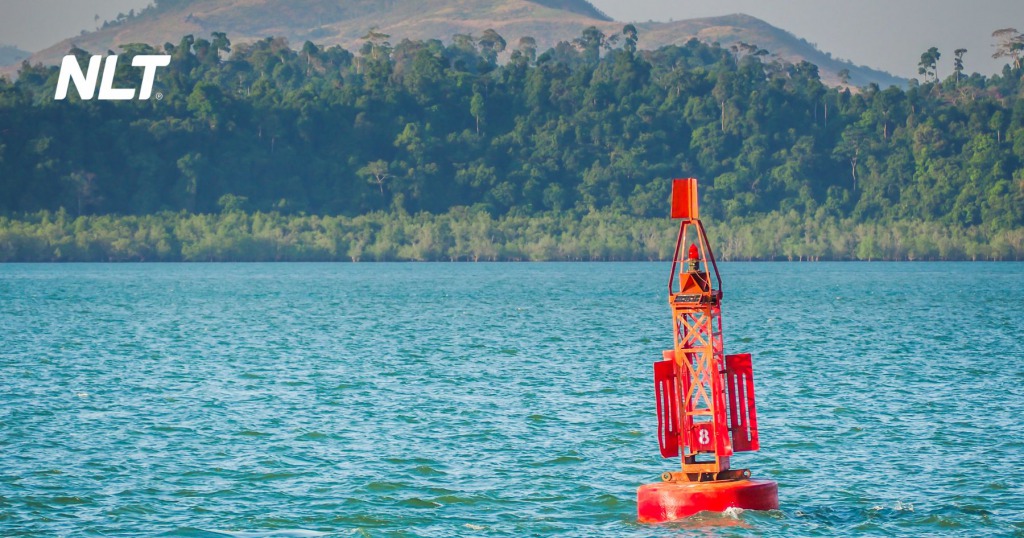
- Port hand and starboard hand buoys: mark the left or right boundaries of the navigation channel according to the direction of travel from downstream to upstream.
- Mid channel buoys: used to identify the centerline of the navigation route.
- Restricted area buoys: used to warn of hazardous areas, prohibited zones, or construction sites.
- Mooring buoys: designate permitted anchorage locations for vessels.
Each buoy type has a specific color scheme such as red, green, yellow, black, or white, a distinct shape such as cylindrical, conical, or spherical, and a light signal programmed with a specific flashing pattern in accordance with national regulations and international standards such as those issued by IALA, the International Association of Marine Aids to Navigation and Lighthouse Authorities.
Why are signal lights important on navigation buoys?
Ensuring inland waterway traffic safety
A buoy that is correctly positioned and painted in standard colors becomes ineffective if its signal light does not operate properly, especially at night or under poor weather conditions such as fog or storms. Signal lights serve as “illuminated eyes” that allow vessels to detect buoy positions from a distance and adjust their course in time to avoid danger. If a buoy drifts from its designated position, the system must immediately issue a warning. If the signal light fails, a fault signal must be transmitted to the control center. This is why signal light standards must be strictly complied with and regularly inspected.
Supporting navigation at night and in adverse weather
In low light conditions or when visibility is reduced by weather, light signals become the only remaining means of navigation guidance. Each buoy type uses a specific light color and flashing pattern. Vessels rely on these signals to determine the port side, starboard side, and hazardous areas to avoid. Understanding and following signal light standards has become an international language on the water. When signal lights flash with the correct pattern and sufficient luminous intensity, vessels can identify routes from a distance, helping to reduce fuel consumption, minimize wasted time, and most importantly, lower the risk of serious collisions.
General technical standards for buoy signal lights
On all waterways, signal lights are not simply auxiliary equipment but a mandatory element from both a legal and operational perspective. In Vietnam, standards for inland waterway buoy signal lights are clearly defined in both national and international regulatory systems.
Legal basis in Vietnam
Compliance with signal light standards is not optional but a legal obligation, as stipulated in:
- Circular 77/2014/TT-BGTVT: promulgating the National Technical Regulation QCVN 39:2011/BGTVT on inland waterway navigation aids.
- QCVN 39:2011/BGTVT: specifying detailed requirements for the design, arrangement, colors, light characteristics, and flashing patterns of signal lights.
- Law on Inland Waterway Transport 2004 (amended 2014): requiring all vessels and navigation aid equipment operating on waterways to comply with technical regulations.
Common international standards (IALA)
The International Association of Marine Aids to Navigation and Lighthouse Authorities (IALA) establishes global standards for navigation aid systems and signal lights used in maritime transport. Vietnam currently applies the IALA Region A system for both inland waterways and coastal maritime navigation. Under this system, buoy signal lights must comply with common conventions regarding:
- Colors: red for port hand, green for starboard hand, yellow for special or warning buoys.
- Flashing patterns: single flash, group flashing, or quick flashing depending on function.
- Visibility range: at least one nautical mile under normal weather conditions.
- Operating duration: at least seven consecutive nights without recharging when using solar power.
Compliance with IALA standards allows Vietnam to align its navigation aid system with international practices, thereby enhancing integration, reducing accident risks, and facilitating the operation of foreign vessels in Vietnamese rivers and coastal waters.
Technical specifications required for signal lights

Signal lights installed on inland waterway buoys are not merely simple light bulbs. They are specialized technical devices that must meet strict specifications in order to be operated in the harsh conditions on the water surface. The selection of lights cannot be arbitrary but must be based on the characteristics of each navigation channel, buoy type, and actual operational requirements.
Luminous intensity (candela)
According to QCVN 39:2011/BGTVT, signal lights must provide sufficient luminous intensity to be recognizable in darkness or light fog conditions. Luminous intensity is measured in candela and varies depending on the buoy type. Specifically:
- Buoys near the shore or on small rivers: minimum 5 to 15 candela
- Buoys on main channels or wide water areas: from 20 to 50 candela or higher
If the intensity is insufficient, the light signal will appear dim and can easily be overwhelmed by ambient light, rendering the warning ineffective.
Nominal range (NM)
Nominal range is the minimum distance at which the light emitted by the signal can be detected by a vessel operator. QCVN 39 requires signal lights to achieve a minimum range of 1 to 3 nautical miles depending on the area. For main channel buoys or marine environments, the required range may reach up to 5 nautical miles. The greater the range, the earlier the signal can be recognized, thereby increasing the vessel’s ability to react in time.
Color and flashing pattern
Signal lights must emit the correct color corresponding to the buoy’s function:
- Red: port hand buoy
- Green: starboard hand buoy
- Yellow: special purpose or warning buoy
- White: mooring buoy or information buoy
The flashing pattern must be accurate according to the design so that vessels can clearly distinguish between different buoy types. For example, a light flashing once every four seconds is completely different from a group flashing three times every ten seconds. The flashing pattern must be programmed as fixed and must not vary abnormally during operation.
Operating duration and solar power battery
Signal lights must operate continuously for at least 7 to 10 nights without recharging if powered by batteries or solar energy. This is particularly important because most inland waterway buoys are located far from shore, are difficult to access, and cannot be maintained frequently. Therefore, the lights must:
- Have an integrated high capacity battery
- Be equipped with a solar panel for automatic daytime charging
- Include an energy saving control circuit and an automatic light sensor for on and off operation
Modern signal light systems from manufacturers such as Sabik from Finland or Sealite from Australia have integrated all of these features. According to the 2024 technical catalog from Sealite, models such as SL-15 or SL-C310 have battery lifespans of up to five years and operate reliably in harsh environments, including tropical marine conditions such as those in Vietnam.
Regulations on installation and inspection of signal lights on buoys
The installation of signal lights cannot be carried out arbitrarily or based on subjective judgment. It must comply with clear technical and legal requirements. Every detail, such as installation position, height above the water surface, and inspection procedures, directly affects the visibility of the signal to vessel operators. Therefore, compliance with signal light standards is essential.
Position of the light on the buoy
According to the guidance in Appendix I of QCVN 39:2011/BGTVT, the light must be installed at the highest point of the buoy to ensure that it is not obstructed by any objects. The minimum distance from the water surface to the light must be 2 meters so that the light can disperse effectively and avoid being submerged by waves. At the same time, the light must be firmly fixed to prevent vibration when the buoy is impacted by waves or strong winds.
Minimum height of the light
Signal light standards require the minimum height from the water surface to the center of the light source to ensure an appropriate projection angle. For typical inland waterways, the minimum height is 1.8 meters. For buoys located at river mouths or marine areas, this height must range from 2.5 to 3 meters to ensure a wider and longer projection range.
Periodic inspection and maintenance
Signal lights must be inspected before installation and periodically checked at least once every six months in accordance with Circular 77/2014/TT-BGTVT. Inspection items include:
- Checking luminous intensity
- Checking whether the flashing pattern matches the design
- Checking the stability of the power supply
- Assessing water resistance, corrosion resistance, and mechanical durability
If any deviation or degradation in quality is detected, the managing unit must immediately replace or rectify the issue. Delays in addressing signal light faults may result in administrative penalties under Decree 139/2021/NĐ-CP, with fines of up to 50 million VND depending on the severity of the violation.
>> See more: Structure of navigation buoys: detailed from inside to outside
Common issues and prevention methods
Insufficient brightness or incorrect flashing pattern
This is the most common issue for inland waterway buoys. The causes may include using non-compliant lights, lights with insufficient luminous intensity, or flashing patterns that do not match the buoy type as specified in QCVN 39:2011/BGTVT. For example, a port-hand buoy is required to use a group flash of three in 10 seconds, but if it is configured as a single flash every five seconds, it can create serious confusion for vessels navigating at night.
Prevention:
- Always use signal lights with clear technical standard certification
- Re-inspect the entire system before putting it into operation
- Periodically check brightness and flashing patterns using specialized measuring instruments
Power supply or sensor failure
Many lighting systems use solar batteries, but after long-term operation under harsh weather conditions such as storms and heavy waves, performance may degrade or the system may fail completely. If the light sensor malfunctions, the light may not turn on at night or may not turn off during daylight, which wastes energy.
Prevention:
- Use lights from reputable brands with IP68-rated waterproofing and corrosion resistance
- Install an additional protective cover for the sensor
- Perform periodic maintenance every 3–6 months to check battery and sensor condition
Installation errors against the standard
In many cases, signal lights are installed in the wrong position or at an incorrect height, causing the signal to be obstructed or the projection angle to be suboptimal. Another common issue is poor fastening, which allows the light to vibrate or change its projection direction under strong waves.
Prevention:
- Strictly comply with the guidance in Appendices I and II of QCVN 39:2011/BGTVT
- Only use installation teams that have specialized training in inland waterway navigation aids
- Recheck the projection angle and mounting height with specialized measuring instruments before handover
NLT Group – A supplier of inland waterway buoys in Vietnam with compliant signal light standards
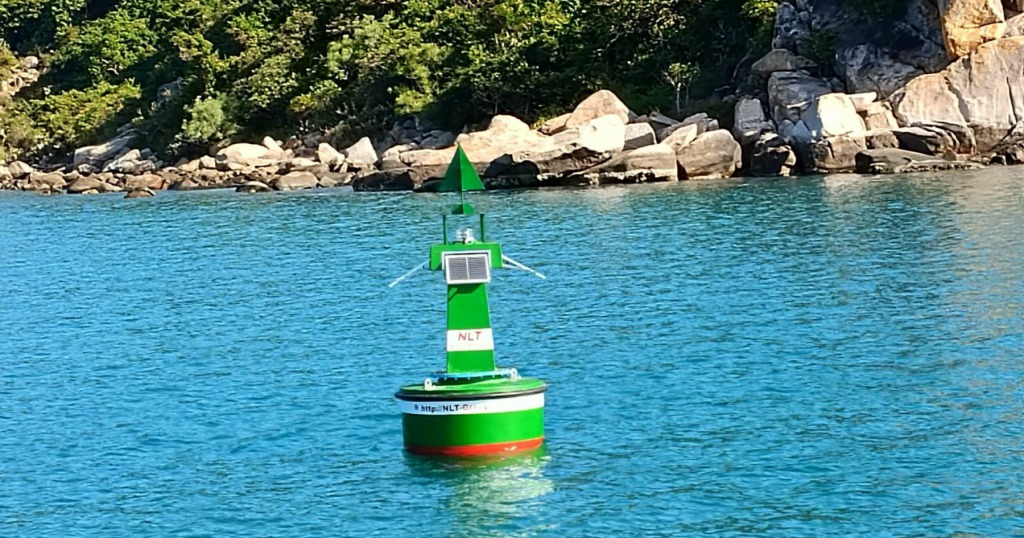
In Vietnam, few organizations have the full capability to design, manufacture, and install inland waterway buoy systems with integrated signal lights in compliance with national regulations and international standards. Among them, NLT Group is one of the pioneering and leading reputable companies in this field.
NLT Group currently supplies and installs inland waterway channel marking buoys, with signal light systems compliant with QCVN 39:2011/BGTVT and the IALA Region A system. The equipment provided by NLT uses high-technology solar-powered lights with stable luminous intensity, automatic light sensors, IP68-rated waterproofing, and a nominal range from 1 to 5 nautical miles depending on operational requirements. A key highlight is that NLT directly manufactures the buoy body using high-strength composite materials with corrosion resistance and suitability for seawater environments.
Conclusion
Signal lights are not just accessories attached to inland waterway buoys but a core factor determining the effectiveness of the entire navigation aid system. Strict compliance with signal light standards, proper equipment selection, accurate installation, and regular inspection are elements that must not be overlooked. Even minor deviations in the signaling system can lead to serious consequences if not addressed promptly.
Nam Long Technology Investment Group (NLT Group)
- Hotline: 0911 379 581
- Email: kinhdoanh@nlt-group.com
- TIN: 0313339640
- Address: 43T Ho Van Hue Street, Duc Nhuan Ward, Ho Chi Minh City
Frequently asked questions (FAQs)
Which flashing cycle must buoy signal lights follow to meet standards?
According to the promulgated signal light standards, flashing cycles must match the buoy type and comply with QCVN 39:2011/BGTVT. For example, a port hand buoy typically flashes a group of three within ten seconds.
Will there be penalties if a buoy signal light is not functioning?
Yes. Under Decree 139/2021/ND-CP, allowing signal lights to operate incorrectly or not operate at all may result in administrative penalties.
Is it mandatory to use solar powered signal lights for buoys?
It is not mandatory, but highly recommended, as solar powered lights ensure continuous operation without relying on external power sources.
Why is periodic inspection of buoy signal lights necessary?
When buoy lights meet signal light standards, inspections help ensure correct luminous intensity, proper flashing cycles, and reliable operation under all weather conditions.
Where can reliable buoy signal lights be purchased in Vietnam?
They can be purchased from NLT Group or authorized distributors of genuine maritime equipment such as Sealite or Sabik with official representation in Vietnam.