Tiếng Việt
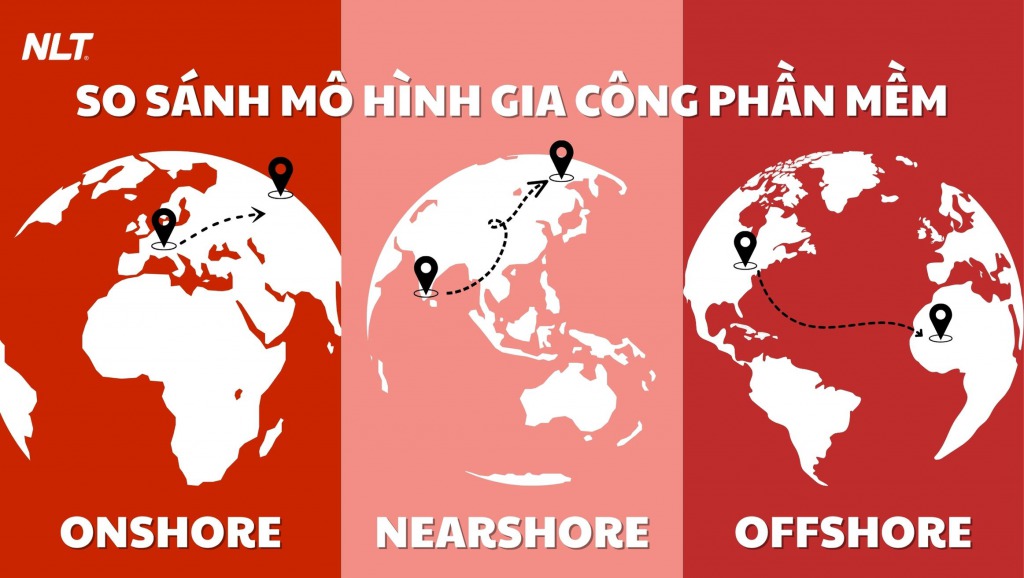
Why do we need to compare software outsourcing models? Because software outsourcing is no longer an option but has become a mandatory strategy for many Vietnamese businesses, from tech startups looking to save costs when developing an MVP to large corporations that need to expand ERP systems or automate operational processes. But when facing three popular models, onshore, offshore, and nearshore, which path is truly optimal? Let’s break down each model from the perspective of the Vietnamese market.
Overview comparison of software outsourcing models
| Model | Definition | Geographic location | Language communication |
| Onshore | Hiring a software development vendor located in Vietnam | Same country (Vietnam) | Vietnamese |
| Nearshore | Hiring an outsourcing vendor in a country close to Vietnam, within the ASEAN region | Near Vietnam (Philippines, Thailand, …) | English |
| Offshore | Hiring a software development vendor in a country far away geographically and in time zone | Different continents (India, Ukraine, …) | English |
>>> See more: What is the onshore model? Everything you need to know about onshore software outsourcing
Detailed comparison by key criteria
| Criteria | Onshore (Vietnam) | Nearshore (ASEAN) | Offshore (India, Ukraine,…) |
| Cost | Medium to high | Medium to low | Lowest |
| Time zone | Fully aligned | Slight difference (0 to 1 hour) | Large difference (4 to 10 hours) |
| Legal | Complies with Vietnamese law, easy to litigate | Regional FTA agreements, contracts need careful review | Depends on partner country, higher risk |
| Communication | Very convenient (Vietnamese) | Relatively convenient (English) | Difficult without strong remote management skills |
| Work culture | Close and easy to align | Relatively close | Clearly different, requires adaptation |
| Technical quality | Varies among local companies | Depends on country (Philippines, Malaysia are good) | Very diverse, from excellent to poor if chosen incorrectly |
| Suitable for | Domestic projects, ERP, government system integration | | | ASEAN projects, hybrid teams, flexible scaling | MVPs, global products, budget optimization |

>>> See more: Offshore model: saving software outsourcing costs but not simple
Pros and cons of each software outsourcing model
| Model | Main advantages | Biggest limitations |
| Onshore | Easy communication in Vietnamese Clear legal framework Good understanding of domestic user behavior | Higher cost than offshore Lack of expertise in new technologies Inconsistent quality |
| Nearshore | Close time zones and similar culture Lower cost than Onshore Optimized for distributed teams | Requires english communication skills Lack of deep expertise in some countries Neutral legal framework |
| Offshore | Lowest cost Easy access to a large talent pool Suitable for global products | Language and time zone barriers Difficult to control without an internal technical team Weak legal framework |
>>> See more: Software outsourcing with the nearshore model and mandatory things businesses must know
Suitable models based on business objectives
| Specific business objective | Recommended model |
| High security requirements, domestic products, integration with government agencies | Onshore |
| Need a fast MVP, low budget, acceptance of remote work | Offshore |
| Rapid team scaling, cost control, near real-time communication | Nearshore |
| Large projects requiring both quality and cost control | Hybrid (Onshore + Offshore) |

Recommended models based on the scale of Vietnamese enterprises
| Business type | recommended model |
| Tech startups with limited budgets | Offshore or Hybrid (internal PM, overseas developers) |
| Medium-sized enterprises needing stable internal applications | Onshore or Nearshore (QA/Support) |
| Large corporations with multiple regional branches | Hybrid (Vietnam Onshore management, Nearshore technical operations) |
Conclusion: which software development model should Vietnamese enterprises choose?
There is no absolutely optimal model, only the model that best fits a company’s goals and resources.
Frequently asked questions (FAQ)
Which model is the most cost-effective if I want to build an MVP within 2 months?
Offshore is the most cost-saving option if you only focus on an MVP, provided that you already have internal technical staff or know how to manage remote teams. However, if you have never implemented outsourcing projects before, you should start with a small contract or a trial sprint.
I am not technically knowledgeable, should I choose Offshore?
No. If a business does not have technical project management personnel such as PM, BA, or CTO, the Offshore model is very risky due to time zone differences, cultural gaps, and difficulties in supervision. You should choose Onshore, Nearshore, or a vendor that can provide end-to-end support from A to Z in Vietnamese.
Does Nearshore require working in English?
Yes. Almost 100% of nearshore partners in the region such as the Philippines, Thailand, and Malaysia do not use Vietnamese. Businesses need to prepare staff who can communicate, write documentation, and review tasks in technical English.
Should I hire Offshore developers and then hire an Onshore team to control quality?
This is exactly the hybrid model, which is very popular among enterprises with experience in multi-phase implementations. For example, a Vietnamese PM handles communication and testing, while the Offshore team is responsible for development. This model balances cost and quality control.
Is software outsourcing in Vietnam still “cheap”?
It is no longer as cheap as it was 5 to 7 years ago. Currently, IT talent in Vietnam is becoming more expensive due to high demand. However, quality, communication ability, security, and response speed remain strong advantages. For projects that require long-term operation and continuous interaction, onshore is still a reasonable investment.
Can I change the outsourcing model after the project has been running for a while?
Yes. Many enterprises start with offshore to reduce initial costs, then gradually shift to onshore or nearshore for maintenance, optimization, or product expansion. As long as you have full source code handover contracts and complete system documentation, the transition is feasible.