Tiếng Việt

In the context of inland and maritime waterway transport developing rapidly and integrating more deeply with international systems, applying international buoy standards to navigation buoys has become a mandatory requirement to ensure maritime safety, harmonize infrastructure, and facilitate navigation for both domestic and foreign vessels. Standards such as IALA and ISO are not merely technical tools but also a common language that enables countries to coordinate effectively across global waterways. So what do international buoy standards regulate? This article by NLT Group will certainly help you stay fully and accurately updated.
Why are international standards needed for navigation buoys?
Establishing international buoy standards aims to ensure consistency and effectiveness in their use worldwide. In the past, differences among national navigation aid systems led to many serious maritime incidents and accidents. Therefore, applying common international buoy standards helps to:
- Ensure maritime safety: Create a consistent and easily understandable navigation aid system for mariners and vessel operators.
- Support international trade: Enable vessels from different countries to adapt more easily and comply with regulations when navigating through various sea regions.
- Enhance management efficiency: Allow authorities to inspect, maintain, and upgrade navigation aid systems more effectively based on established standards.
Overview of the international buoy standards system
Major standard-setting organizations: IALA, ISO, IMO
In the fields of maritime and inland waterway transport, three major international organizations play a key role in establishing and maintaining standards for navigation buoys:
- IALA (International Association of Marine Aids to Navigation and Lighthouse Authorities): Established in 1957, IALA focuses on improving and harmonizing marine navigation aid systems worldwide. The organization provides technical guidelines and standards to ensure safety and efficiency in maritime navigation.
- ISO (International Organization for Standardization): ISO develops international standards across many sectors, including maritime technology. ISO standards related to navigation buoys focus on design, materials, and operational performance.
- IMO (International Maritime Organization): As a specialized agency of the United Nations, IMO is responsible for maritime safety and the prevention of marine pollution. The organization issues regulations and guidelines related to the use and maintenance of navigation buoys in the maritime industry.
Types of standards applied globally
Technical standards (materials, durability, lighting)
Technical standards ensure that navigation buoys are designed and manufactured to withstand harsh environmental conditions and operate effectively. They include:
- Materials: Use of corrosion-resistant and high-durability materials to ensure buoy longevity in marine environments.
- Durability: Buoy design must withstand impacts and pressure from waves and wind.
- Lighting: Buoy lighting systems must meet requirements for intensity and flashing frequency to ensure visibility in low-light conditions.
Operation and maintenance standards
In addition to design and manufacturing, standards also regulate the operation and maintenance of navigation buoys:
- Installation: Buoys must be installed at the correct locations and in accordance with technical guidelines to ensure effective signaling.
- Periodic maintenance: Regular inspections and maintenance are required to promptly detect and address damage or deviations.
- Recording and reporting: Maintenance records and incident logs must be maintained to support management and continuous improvement.
ISO standards related to waterway buoys

ISO 17357 (for rubber fenders used in maritime applications)
ISO 17357 is an international standard specifying materials, performance, and dimensions for pneumatic rubber fenders used to absorb impact when vessels berth or moor. This standard consists of two parts:
- ISO 17357-1:2014: Applicable to high-pressure pneumatic rubber fenders.
- ISO 17357-2:2014: Applicable to low-pressure pneumatic rubber fenders.
These fenders are commonly known as “Yokohama fenders” and are widely used in the maritime industry. They are designed to absorb impact energy between vessels and berths or between vessels themselves, ensuring safety during berthing operations and minimizing damage to both ships and port structures.
ISO 9001 Quality management in buoy manufacturing
ISO 9001:2015 is an international standard for quality management systems, applicable to all organizations, including manufacturers of waterway buoys. Implementing ISO 9001 helps businesses ensure that their products meet quality requirements and customer expectations. This standard emphasizes continuous improvement, customer satisfaction, and compliance with applicable regulations.
Buoy manufacturers certified to ISO 9001 typically maintain tightly controlled production processes, from design and material selection to manufacturing and final quality inspection. This ensures that produced buoys not only meet technical standards but also deliver high reliability and long service life.
ISO 12944 Corrosion protection for metal structures exposed to seawater
ISO 12944 is an international standard for corrosion protection of steel structures using protective paint systems. This standard is particularly important for metal waterway buoys that are frequently exposed to highly corrosive marine environments.
ISO 12944 classifies corrosive environments into categories ranging from C1 (very low) to CX (extremely high) and recommends suitable coating systems for each category. In addition, the standard specifies coating thickness, surface preparation methods, and required testing to ensure effective corrosion protection throughout the product lifecycle.
Comparison between international buoy standards and Vietnamese regulations
| Criteria | International standards (IALA, ISO) | Vietnamese regulations (QCVN) |
| Issuing authority | IALA (marine aids to navigation), ISO (technical standards), IMO (international maritime governance) | Ministry of Transport of Vietnam – Circulars and National Technical Regulations (e.g. QCVN 39:2020/BGTVT, QCVN 72:2022/BGTVT) |
| Scope of application | Global, applied across many countries within international maritime and trade systems | Applied within the territory of Vietnam, serving inland waterways and seaports |
| Technical details | Highly detailed: material classification, anti-corrosion coating systems (ISO 12944), quality management (ISO 9001), impact energy absorption requirements (ISO 17357) | Provides general requirements on shape, color, signal lights, materials, and buoy classification, but lacks in-depth specifications for environmental conditions |
| Level of international alignment | High, harmonized with regional and global standards | Integration is gradually improving but there remains a gap compared to international standards |
| Inspection and certification | Inspected by independent international organizations, with ISO/IALA/IMO certifications | Inspected by Vietnam Register or agencies under the Ministry of Transport, issuing domestic technical and operational certificates |
| Advantages | High quality, strong reliability, easier access to international markets | Suitable for local conditions, lower cost, easier to implement |
| Limitations | High investment cost, stringent technical and management requirements | Some standards remain general and have not fully kept pace with technological advances and complex environments such as deep-sea areas or highly internationalized ports |
Practical application of international buoy standards across countries
The United States and the “Red Right Returning” system – IALA B
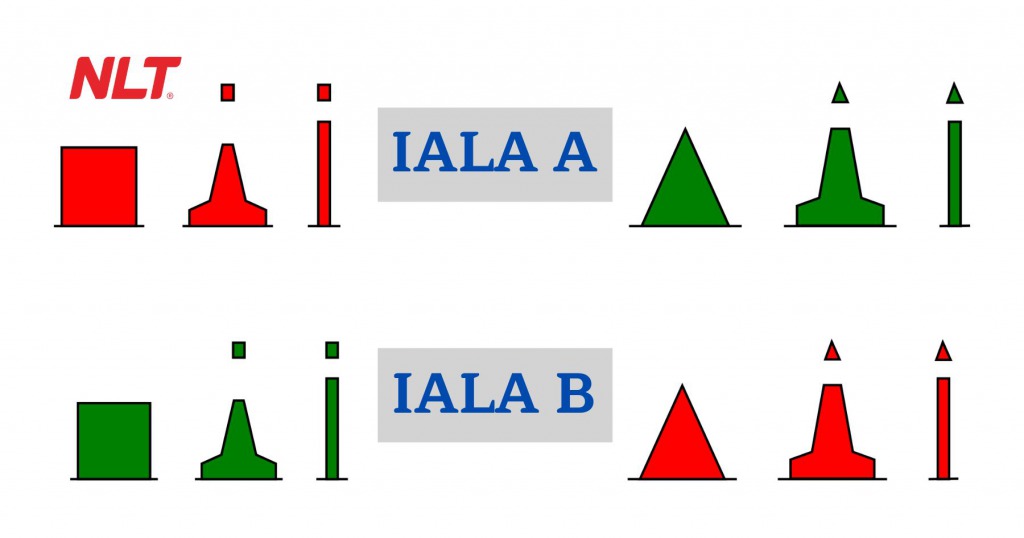
The United States applies the IALA B, maritime buoyage system, in which the “Red Right Returning” rule is widely used. Under this rule, when a vessel is returning to port or traveling upstream, red buoys must be kept on the vessel’s right-hand (starboard) side. This helps mariners maintain accurate orientation and ensures safe navigation within channels and waterways.
European countries apply IALA A and ISO standards
European countries such as France, Germany, and the United Kingdom apply the IALA A system, where, when vessels enter a harbor, red buoys are on the left-hand (port) side and green buoys are on the right-hand (starboard) side. In addition, these countries also comply with ISO standards such as ISO 9001 for quality management and ISO 12944 for corrosion protection of metal structures exposed to seawater, to ensure buoy durability and performance in harsh maritime environments.
Japan, South Korea, and the trend of integrating technology into buoys
Japan and South Korea, although within the IALA B region, have been at the forefront of integrating technology into navigation buoy systems. These countries use technologies such as the VHF Data Exchange System (VDES) to enhance remote monitoring and control capabilities for buoys. This not only improves waterway traffic management efficiency but also strengthens maritime safety.
Inspection and certification under international buoy standards

Certification process under IALA and ISO
To ensure navigation buoys meet international buoy standards, manufacturers and regulators need to follow a rigorous certification process:
- Design and material assessment: Verify technical specifications, materials used, and the overall buoy design.
- Performance testing: Conduct tests for durability, buoyancy, and lighting performance in accordance with standards such as ISO 17357 and ISO 12944.
- Quality management system certification: Ensure the manufacturer has an appropriate quality management system, typically in line with ISO 9001.
- Certificate issuance: After completing the steps above, the certification body issues the relevant certificate, confirming the buoy meets international technical and operational requirements.
Authorized inspection and certification organizations
Organizations with authority to inspect and certify navigation buoys under international buoy standards include:
- International Association of Marine Aids to Navigation and Lighthouse Authorities (IALA): Provides technical guidelines and standards for marine aids to navigation systems.
- International Organization for Standardization (ISO): Develops and maintains international standards related to buoy design, manufacturing, and quality management.
- International classification and certification bodies: Such as Lloyd’s Register, Bureau Veritas, and Det Norske Veritas (DNV), which conduct inspections and issue certifications for maritime products.
Requirements for documentation, testing, and warranty
To obtain certification under international buoy standards, manufacturers and regulators need to prepare and implement the following requirements:
- Technical dossier: Including design drawings, technical specifications, and documentation related to materials and production processes.
- Test reports: Results from durability, buoyancy, lighting performance, and corrosion resistance testing.
- Warranty policy: Commitments on warranty duration and scope, ensuring manufacturer responsibility for buoy quality.
- Quality management system certificate: Confirmation that the manufacturer complies with quality management standards such as ISO 9001.
Conclusion
As global waterway transport becomes increasingly complex and integrated, applying international buoy standards such as IALA and ISO in the design, manufacturing, and management of navigation buoys is inevitable. International buoy standards not only ensure technical safety and stable operation but also enable Vietnam to gradually harmonize its waterway infrastructure with regional and global systems. However, this process requires close coordination among regulatory authorities, enterprises, and inspection organizations to ensure quality while remaining aligned with practical conditions.
FAQ – Answers to 5 frequently asked questions
How are IALA and ISO different?
IALA is an international organization specializing in establishing standards for maritime navigation aids such as lights, buoys, and beacons, with a strong focus on navigational rules and systems. Meanwhile, ISO is an international standardization organization with a broader scope, covering quality management, material engineering, and corrosion protection, which are technical factors related to buoy performance and durability.
Is Vietnam required to apply IALA standards?
Yes. Vietnam currently applies the IALA A system across all inland waterways and maritime routes. This is clearly stipulated in regulations such as QCVN 39:2020/BGTVT and technical guidelines on maritime signaling. Compliance ensures that international vessels entering Vietnamese ports can navigate easily and operate safely.
Can domestically manufactured buoys meet international standards?
Absolutely. Many domestic manufacturers such as NLT Group, Vinawaco, and marine engineering companies have achieved ISO 9001 certification and produce buoys that meet international inspection standards (for example ISO 17357, ISO 12944). However, this requires complete technical documentation, physical testing, and certification issued by competent authorities.
How can you verify whether a buoy meets international standards?
You can check through:
– ISO/IALA certificates or accompanying inspection reports
– Information printed or engraved directly on the buoy (serial number, manufacturer, year of manufacture, protection rating, etc.)
– Legal documents such as certificates of conformity, compliance certificates, or contracts issued by inspection authorities
Inspection is typically conducted by organizations such as Vietnam Register (VR), DNV, Bureau Veritas, or Lloyd’s Register.
When is it necessary to switch from the IALA A system to IALA B, or vice versa?
In practice, each country applies only one system, either IALA A or IALA B. System conversion is not common because it affects the entire infrastructure system, navigation charts, and operational habits. However, for international vessels operating across regions that use different systems (for example traveling from Asia to the United States), crews must clearly understand the differences between the two systems to navigate safely.