Tiếng Việt
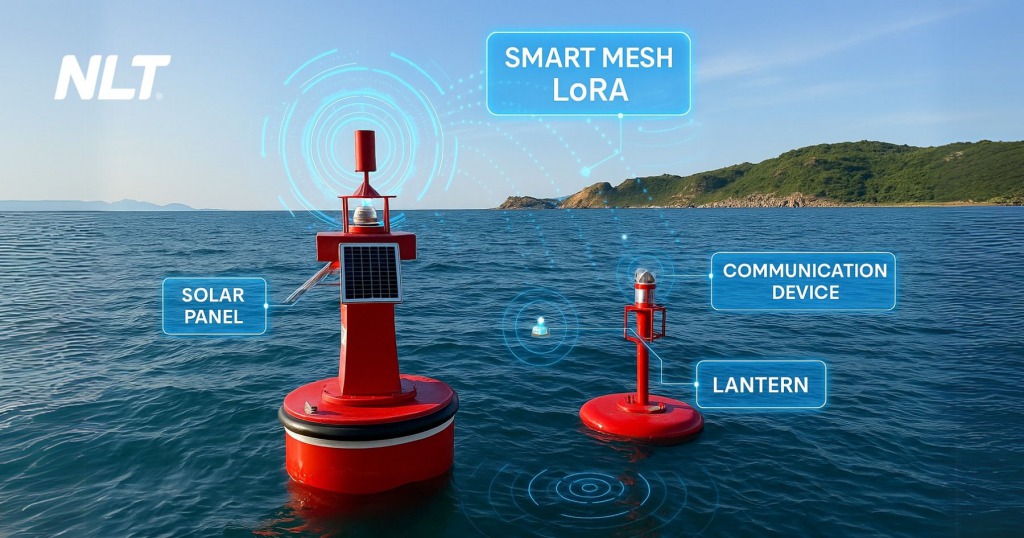
As inland waterway traffic becomes increasingly complex and demands higher standards of monitoring and safety management, smart technology solutions are emerging as an inevitable trend. One of the most notable advances today is the application of Smart Mesh LoRa technology to inland waterway buoy systems. This solution allows buoys to “communicate” with one another and with the operations center autonomously, without relying on traditional cellular networks or the public internet.
So what exactly is this technology, and why is it considered the future of inland waterway infrastructure? Let’s take a closer look in the analysis below.
What is Smart Mesh LoRa?
The concept of Smart Mesh LoRa technology
LoRa (Long Range) is a long-range wireless communication technology with extremely low power consumption, designed specifically for IoT (Internet of Things) applications. It enables data transmission over distances of up to tens of kilometers without relying on cellular networks or Wi-Fi.
Smart Mesh is a network model in which each device (node) functions both as a signal receiver and as a relay that can forward data to other devices. This allows the network to scale flexibly without requiring a fixed central station.
When these two technologies are combined, Smart Mesh LoRa forms a powerful, energy-efficient, and highly resilient connectivity system. This combination is particularly suitable for inland waterway environments, where electrical and network infrastructure is often unstable or completely unavailable.
Operating principles of a Smart Mesh network
Unlike traditional point-to-hub networks, Smart Mesh operates on a distributed principle. Each device in the network can:
- Send data directly to a central receiving point (gateway).
- Or forward data through neighboring nodes if the distance is too great or if obstacles interfere with direct transmission.
In this model, devices automatically select the shortest and most stable path for data transmission. If one node fails or loses signal, the system automatically reroutes data so it can still reach its destination without interruption.
This mechanism enhances network resilience, minimizes the risk of connection loss, and optimizes energy consumption because nodes only operate when necessary.
Why combine LoRa with a mesh model in waterway environments
Inland waterway and maritime environments have several distinctive characteristics:
- Large distances between buoys, spread along rivers, canals, or offshore routes.
- Limited or impractical options for deploying power lines and network cables to each buoy.
- Unstable mobile signals, especially in island areas, estuaries, or remote anchorage zones.
For these reasons, using LoRa with its long-range, low-power characteristics combined with a mesh network capable of flexible routing becomes an ideal solution for modern navigation buoy systems.
Specific applications in smart navigation buoy systems
How LoRa Mesh-enabled buoys operate
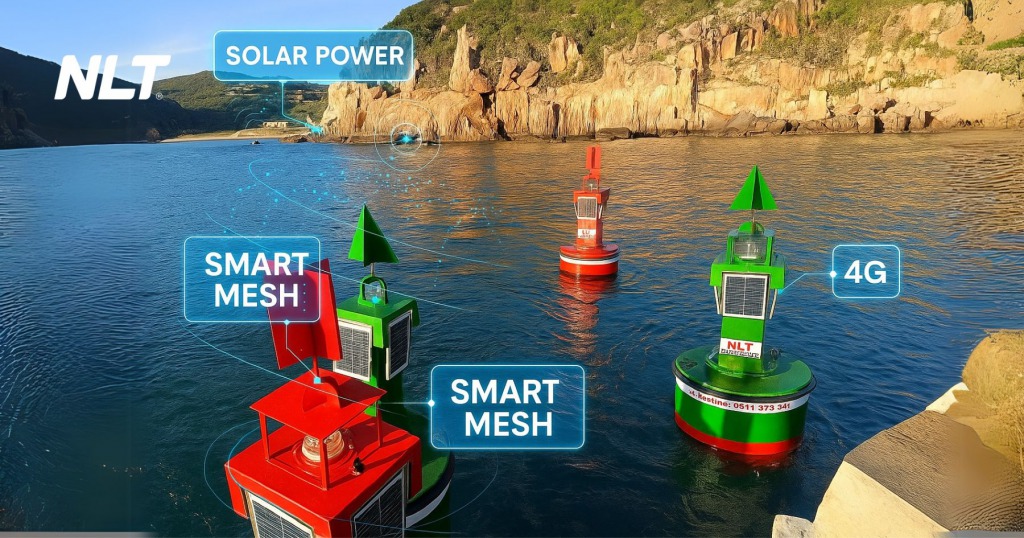
Each buoy is equipped with a LoRa communication module and connects with nearby buoys to form a mesh network. Through this network, buoys can:
- Transmit data directly to a shore-based gateway when within range.
- Or relay signals through intermediate buoys until the data reaches the operation center.
Types of data transmitted: positioning, alerts, and device status
Smart Mesh LoRa technology allows navigation buoys to do far more than simply emit light or remain stationary. Buoys can:
- Transmit GPS positioning data to determine whether they have drifted from their designated location.
- Report the operating status of lights, batteries, water-level sensors, or tilt sensors.
- Automatically send alerts when system faults occur, battery levels are low, or buoys tilt due to collisions.
As a result, management units can monitor the entire buoy system in real time without relying on routine manual inspections as before.
Self-routing and network recovery mechanisms during failures
The greatest strength of Smart Mesh lies in its ability to self-heal the network when failures occur. If a buoy experiences a fault such as device damage, power loss, or submersion due to impact, neighboring buoys will automatically reroute signals through alternative paths without interrupting data transmission.
Because the system does not rely on a single central point, it offers high stability and strong fault tolerance. This makes Smart Mesh LoRa particularly suitable for applications that require high levels of safety and reliability, such as inland waterway navigation signaling systems.
Benefits of applying Smart Mesh LoRa in inland waterway buoys
Real-time remote monitoring
Previously, monitoring the operational status of navigation buoys relied mainly on personnel traveling directly to the site. This approach was time-consuming, costly, and unable to detect incidents immediately. With the support of Smart Mesh LoRa, this challenge is effectively addressed. Each buoy continuously transmits real-time data to the operations center, including operational status, battery level, position, and fault alerts.
Cost savings and reduced dependence on manpower
Maintaining traditional buoy systems requires significant expenditure for periodic inspections, mechanical repairs, and patrol manpower. When integrating LoRa Smart Mesh, many of these costs are substantially reduced:
- No need for routine on-site inspections by boats as long as the system operates normally.
- No requirement to invest in wired networks or fixed transmission infrastructure.
- Reduced dependence on on-site personnel while still having full access to essential operational data.
Enhanced stability and safety for inland waterway traffic
Maritime and inland waterway safety depends heavily on the reliability of navigation aids. A buoy drifting off position, losing its light, or going offline can lead to serious accidents. With a Smart Mesh LoRa network, any abnormal change is updated immediately:
- Loss of connectivity is detected and recorded instantly.
- The mesh network can automatically reroute data if a buoy encounters a fault.
- The operations center can issue alerts to local monitoring stations or relevant authorities in a timely manner.
>> See more: Guide to selecting standard, effective, and purpose-appropriate inland waterway buoys
Challenges and considerations during deployment
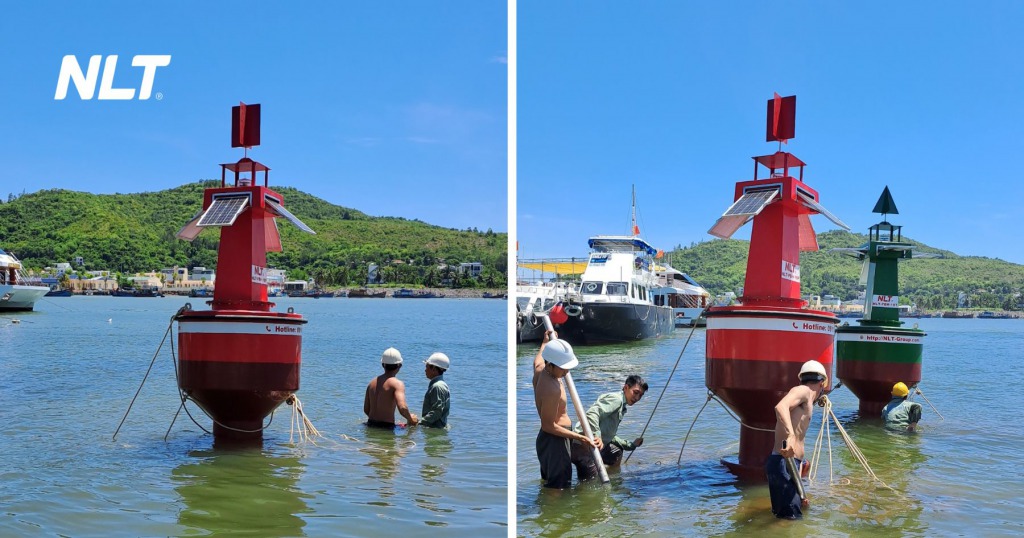
Connectivity issues in complex terrain
Although LoRa stands out for its long transmission range and strong penetration capability, in certain specific terrains such as winding rivers with many bends or coastal areas frequently affected by strong winds and high waves, signal degradation may still occur. This can result in data packet loss or temporary connection interruptions.
Requirements for gateways and operations servers
A Smart Mesh LoRa network still requires gateway stations to collect data from buoys and transmit it to the operations center. These gateways must:
- Be installed at elevated, open locations with good coverage.
- Maintain stable connectivity to the operations center via LAN, 4G, or satellite links.
- Be synchronized with servers or operations software capable of storing, analyzing, and displaying data from multiple buoys simultaneously.
In addition, the system must be designed with tight integration between hardware (buoys and gateways) and software (monitoring platforms) to prevent data loss or incorrect status reporting.
Initial investment costs and technical training
A buoy system utilizing LoRa Mesh can deliver long-term benefits, but the initial investment cost is relatively high. This remains a significant barrier for many managing organizations with limited budgets or without a mature digital transformation foundation. However, with coordinated investment policies and support from higher-level authorities, this solution can deliver outstanding technical and financial efficiency over the long term.
The future of Smart Mesh LoRa in inland waterway transportation
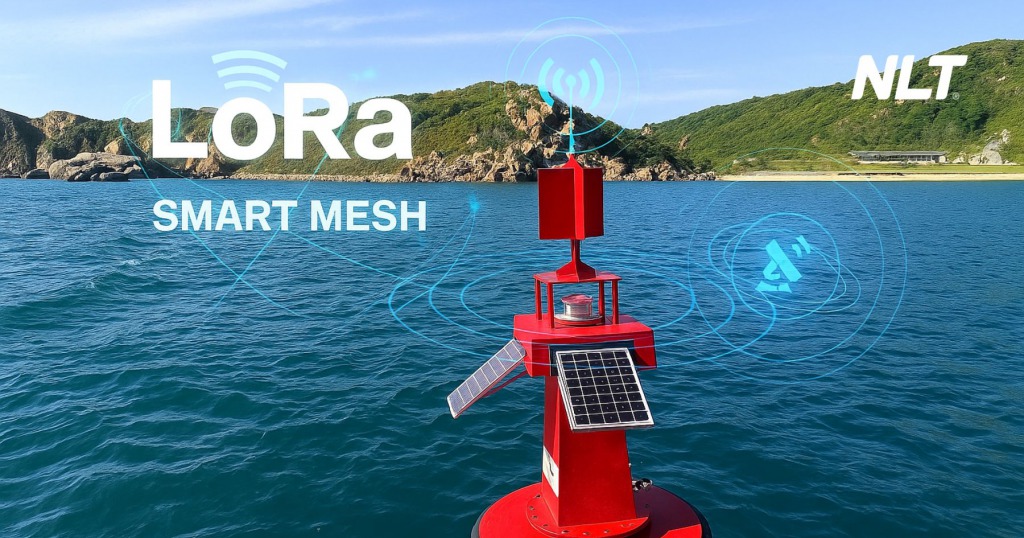
Its role in smart cities and smart ports
Within the smart city and smart port ecosystem, navigation aids such as inland waterway buoys will no longer function as isolated, passive devices. Instead, they must become integral components of a comprehensive IoT network. Smart Mesh LoRa serves as an ideal connectivity foundation by:
- Enabling the integration of navigation-aid data into urban traffic management systems.
- Supporting remote management of inland waterways, inland ports, and tourist terminals.
- Providing the basis for developing smart port operation centers with real-time connections to buoys, current sensors, maritime radar systems, and hydrological forecasting data.
Scalability for nationwide deployment
The Smart Mesh LoRa model is not limited to local-scale applications. On the contrary, it is highly suitable for large-scale deployment thanks to the following characteristics:
- No need for cabling or grid power, reducing initial infrastructure costs.
- Each buoy cluster can operate as an independent network while remaining interoperable when required.
- Easy expansion by adding new devices or replacing faulty nodes without disrupting the entire system.
This opens up opportunities for the Ministry of Transport and local Departments of Transport to coordinate the deployment of a national smart buoy network, from the Mekong Delta to the Red River system and coastal regions.
Integration with satellite data and GIS digital maps
Smart Mesh LoRa is not limited to signal transmission alone. It also establishes a big-data foundation to support:
- Analysis of inland waterway traffic flows, vessel density, and congestion points.
- Forecasting congestion risks, accidents, and early warnings for buoys drifting out of position.
- Real-time visualization on GIS digital maps, supporting route planning, vessel management, and regional waterway traffic coordination.
By combining satellite data (GPS and remote sensing imagery) with on-site data collected from buoys, authorities can make more accurate and timely decisions, while also developing more effective long-term strategies for inland waterway transportation.
Conclusion
While many sectors have already undergone strong transitions toward smart models, inland waterway transportation, often regarded as the silent backbone of the economy, cannot remain on the sidelines. Applying Smart Mesh LoRa technology to navigation buoy systems is not merely a technical choice, but an inevitable requirement to ensure safety, efficiency, and proactive route management.
With robust connectivity, low energy consumption, self-healing network capabilities, and seamless integration into remote monitoring platforms, LoRa Smart Mesh is poised to become the core infrastructure for next-generation inland waterway navigation systems in Vietnam.
Nam Long Technology Investment Group (NLT Group)
- Hotline: 0911 379 581
- Email: kinhdoanh@nlt-group.com
- TIN: 0313339640
- Address: 43T Ho Van Hue Street, Duc Nhuan Ward, Ho Chi Minh City
FAQ
How is LoRa different from Wi-Fi?
LoRa is a long-range wireless data transmission technology that consumes very little power and operates independently, while Wi-Fi requires a fixed internet connection, has a shorter coverage range, and consumes more energy. LoRa is well suited for outdoor devices that do not require continuous internet connectivity.
If one buoy fails, will the system lose connectivity?
No. A Smart Mesh network allows buoys to reroute signals through other nodes if one buoy encounters a failure. The system automatically maintains connectivity and ensures that data continues to be transmitted to the operations center.
What is the maximum distance between buoys?
Depending on terrain and environmental conditions, the distance between buoys can range from around 500 meters to more than 2 kilometers. In open environments with minimal signal interference, LoRa can transmit over even longer distances, especially across water surfaces